The 4-Day Launch: Why Your LMS Should Be a Product Factory, Not Just a Ledger
The Hard-Coded Trap
In lending, speed compounds.
If a competitor launches a Monsoon Agri Loan or a Festive Consumer Durables offer and you take three months to respond, the market has already moved on. By the time your product is live, distribution momentum — and borrower attention — is gone.
In most cases, the delay isn’t caused by approvals, compliance, or even intent.
It’s caused by rigid system design.
Many Loan Management Systems are built with a specific lending model in mind. An LMS optimized for Personal Loans struggles when asked to support Construction Finance. A system designed for EMI-based products resists anything seasonal, step-up, or irregular.
Every new product then turns into a coordination exercise:
- Logic discussions
- Edge-case handling
- Regression testing
- Release scheduling
What should be a business decision becomes a technology project.
When Product Launches Depend on Code
In hard-coded systems, launching a new product usually means:
- Interest logic embedded directly in workflows
- Repayment structures assumed upfront
- Tenure and accrual rules fixed early
Over time, even small variations — different moratoriums, seasonal schedules, benchmark-linked rates — require custom handling.
This creates two structural problems:
- Engineering bandwidth becomes a recurring bottleneck
- Product experimentation slows down precisely when growth depends on it
The result isn’t just slower launches. It’s fewer experiments, higher risk per launch, and conservative product decisions.
The Product Factory Approach
Encore takes a fundamentally different approach.
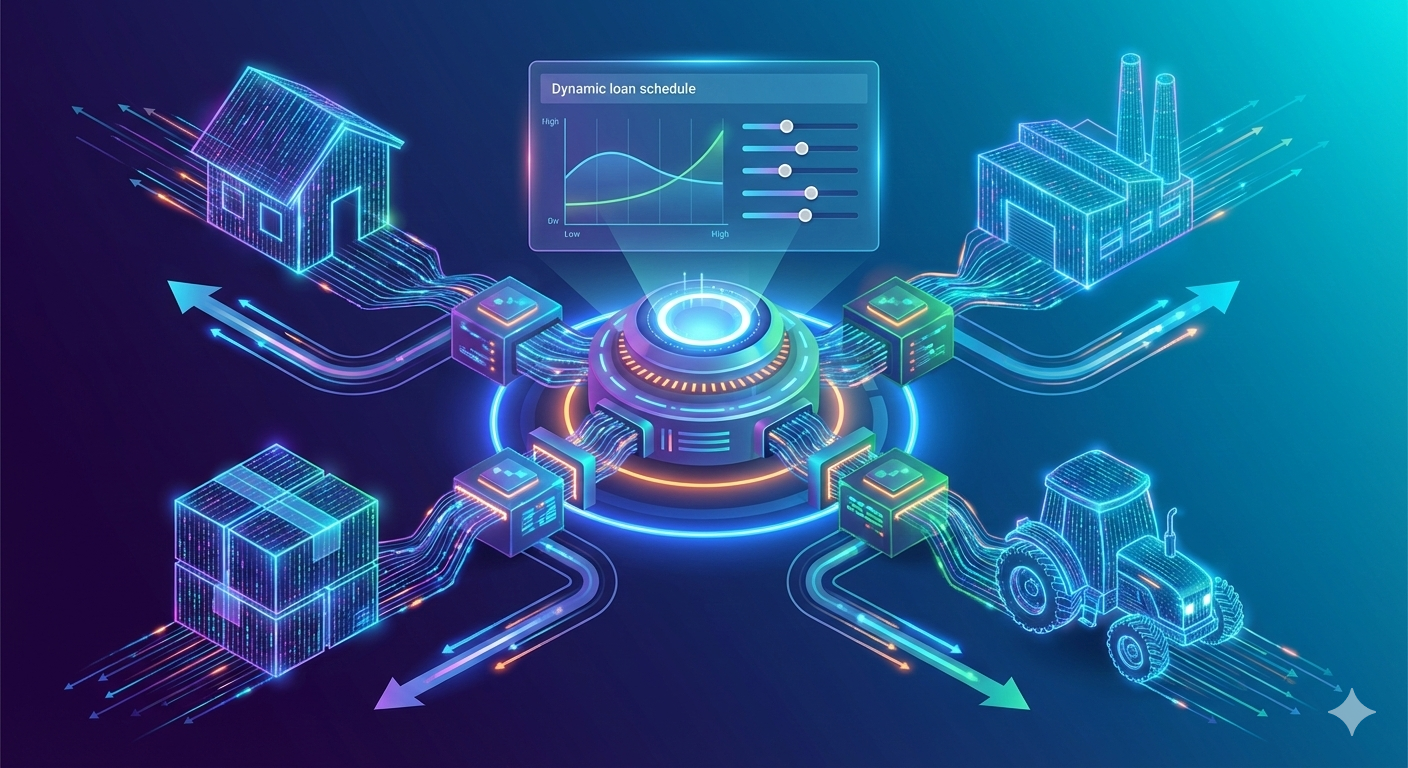
Instead of treating the LMS as a static ledger with workflows layered on top, Encore is designed as a configurable product engine — a system where lending products are assembled, tested, and launched through parameters, not code.
The core idea is simple:
Separate the mathematics of lending from the meaning of the product.
Whether you’re offering:
- Housing Loans with long tenures and floating rates
- Supply Chain Finance with short cycles and invoice-based structures
- Agri Loans with harvest-linked seasonality
The same engine supports them — without rewriting logic.
How a Configurable LMS Changes Go-To-Market Execution
1. Clone, Then Iterate — Not Rebuild
Most new products are variations of existing ones.
A “Prime Personal Loan” isn’t a reinvention — it’s a refinement:
- Slightly lower rates
- Higher ticket sizes
- Tighter eligibility
With a configurable engine:
- Existing products can be cloned
- Only the differing parameters are adjusted
- The core behavior remains stable and proven
This reduces launch risk while dramatically improving speed.
2. Validate the Math Before Real Money Is Involved
Complex products fail quietly — often after disbursal.
Step-up EMIs, moratorium structures, and penalty logic may look correct on paper but behave differently across time.
Encore includes pre-launch simulation directly within the product setup:
- Generate sample repayment schedules
- Validate accruals and penalty calculations
- See exactly what borrowers and operations teams will see
This shifts validation left — before the first loan is booked.
3. Controlled Rollouts Instead of All-or-Nothing Launches
Nationwide launches are risky, especially for new structures.
Encore allows products to be:
- Restricted to specific branches or regions
- Activated on predefined dates
- Automatically expired after promotional windows
This enables:
- Pilot launches
- Controlled exposure
- Faster learning cycles
Growth becomes iterative, not binary.
4. One Engine, Multiple Lending Verticals
As portfolios diversify, many lenders end up running:
- One system for MSME
- Another for Corporate
- A third for Housing or LAP
This fragmentation increases reporting, reconciliation, and compliance complexity.
Encore’s parameterization supports multiple lending models simultaneously:
- MSME: Daily or weekly operational structures
- Corporate: Balloon payments and moratoriums
- Housing / LAP: Benchmark-linked floating rates
- Supply Chain: High-velocity, short-tenure revolving credit
All within a single ledger and control framework.
Innovation Without Dependency Chains
A configurable LMS doesn’t remove engineering from the picture — it puts engineering effort where it belongs.
Instead of repeatedly implementing product logic, teams can focus on:
- Platform stability
- Scale
- Integrations
- Compliance resilience
For business teams, this means:
- Faster experimentation
- Lower launch risk
- Better alignment between strategy and execution
Growth stops being constrained by system rigidity.
Curious how quickly a new loan product can be launched in practice?
Book a Demo
to see how Encore Lend enables teams to configure, simulate, and launch new lending products in days — not months.