Stop Polling: Why Modern Lending Stacks Must Be Event-Driven
Stop Polling: Why Modern Lending Stacks Must Be Event-Driven
It’s the 5th of the month.
Your BI dashboard shows NPA at 2.3%.
Your Operations screen shows 2.1%.
Collections insists yesterday’s payments haven’t been reflected yet.
No system is down.
No one made a mistake.
This mismatch happens because most lending stacks still rely on delayed, snapshot-based data synchronization — an approach that quietly breaks as transaction volumes, reversals, and partner integrations scale.
Modern lenders don’t fail because they lack software.
They fail because their systems stop agreeing with each other.
Monolithic Lending Is Already Dead — Synchronization Is the Real Problem
Today’s digital lenders rarely operate on a single application.
A typical lending stack includes:
- An LOS (Loan Origination System) for onboarding and underwriting
- An LMS (Loan Management System) for servicing and ledger
- A Collections system for recovery operations
- An ERP or General Ledger for accounting and reporting
- External payment gateways, banks, and LSPs
Building these systems is no longer the hard part.
Keeping them perfectly synchronized under real-world conditions is.
Why Polling Breaks at Scale (Even When It “Works”)
Most integrations still rely on polling:
“Has anything changed?”
“Any new payments?”
“Any reversals since the last sync?”
Early on, this approach looks harmless.
At scale, it becomes fragile.
In real NBFC deployments, polling commonly leads to:
- Data latency between systems
- API rate limits being hit during peak hours
- Silent reconciliation drift
- Incorrect calling, reporting, and customer communication
The most dangerous part?
Polling failures are rarely obvious. Everything looks “mostly right” — until month-end.
The Shift to Event-Driven Lending Architecture
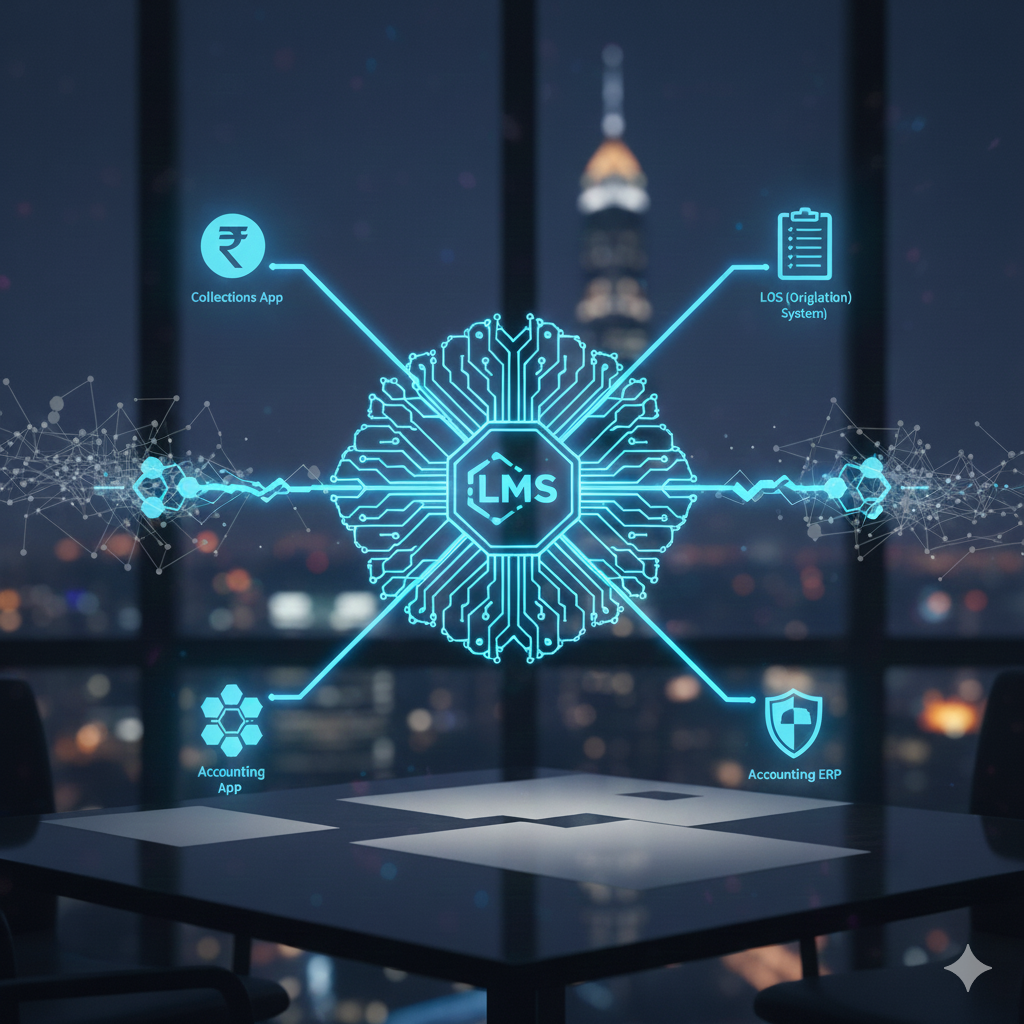
Encore Lend replaces polling with a push-based, event-driven model using webhooks.
Instead of downstream systems repeatedly asking the LMS for updates, Encore broadcasts domain events the moment they occur — disbursals, repayments, reversals, and state changes.
This transforms the LMS from a passive database into an active system of record that keeps the entire stack aligned in near real time.
What This Changes in Real Operations
1. Real-Time Collections Sync
Collections is often the first place synchronization issues surface.
What typically happens:
- A borrower pays via UPI or a payment link
- The LMS records the payment immediately
- The Collections system syncs on an hourly or EOD batch
- An agent still calls the borrower
That single call damages trust — and it happens more often than teams admit.
With event-driven webhooks:
- Encore records the repayment
- A
repayment.successevent is fired instantly - The Collections system removes the loan from calling queues in real time
No reconciliation lag. No awkward conversations.
2. Seamless LOS to LMS Hand-Offs
Loan booking is another frequent friction point.
In polling-based setups:
- The LOS submits the booking request
- The LMS processes it
- The LOS waits or retries
- Customers see “processing” screens or delayed confirmations
With Encore’s event model:
- Once the loan account is created, Encore emits an
account.createdevent - The LOS receives the account number, schedule, and metadata instantly
- Borrowers land on their dashboard without delay or uncertainty
This reduces onboarding drop-offs and support tickets significantly.
3. Reversals: The True Integrity Test
Most systems handle positive flows well.
Reversals are where integrations fail.
Cheque bounces.
Payment gateway retries.
Manual corrections by operations teams.
In polling architectures, reversals often:
- Update the LMS
- Miss one or more downstream systems
- Leave GL, BI, and customer apps out of sync
Encore treats reversals as first-class domain events.
When a transaction is reversed:
- A
disbursement.reversedorrepayment.reversedevent is emitted - Downstream systems automatically roll back balances
- Financial consistency is preserved without manual cleanup
Designing Webhooks for Production Reality
Event-driven systems introduce new challenges — ignoring them is how bad architectures are built.
Encore’s webhook engine is designed for real lending environments:
-
Granular subscriptions
Collections listens only to repayment events
Accounting listens only to ledger-impacting events -
Standardized, versioned JSON payloads
Predictable schemas reduce fragile integration logic -
Reliable delivery and retries
Temporary endpoint failures don’t result in data loss -
Idempotency and ordering safeguards
Duplicate or delayed events don’t corrupt balances
These are lessons learned from real lending systems — not just architecture diagrams.
From Passive LMS to Reactive Financial Core
In high-volume digital lending, end-of-day synchronization is already too late.
Borrowers act in real time.
Payments arrive continuously.
Reversals don’t wait for batch windows.
By adopting an event-driven architecture, Encore Lend turns your LMS into the reactive backbone of your lending stack, keeping Origination, Collections, Accounting, and Reporting aligned as the business actually operates.
Still relying on polling or batch jobs to keep systems in sync?
Book a Demo
to see how Encore Lend’s event-driven webhooks eliminate data latency across your lending stack.